

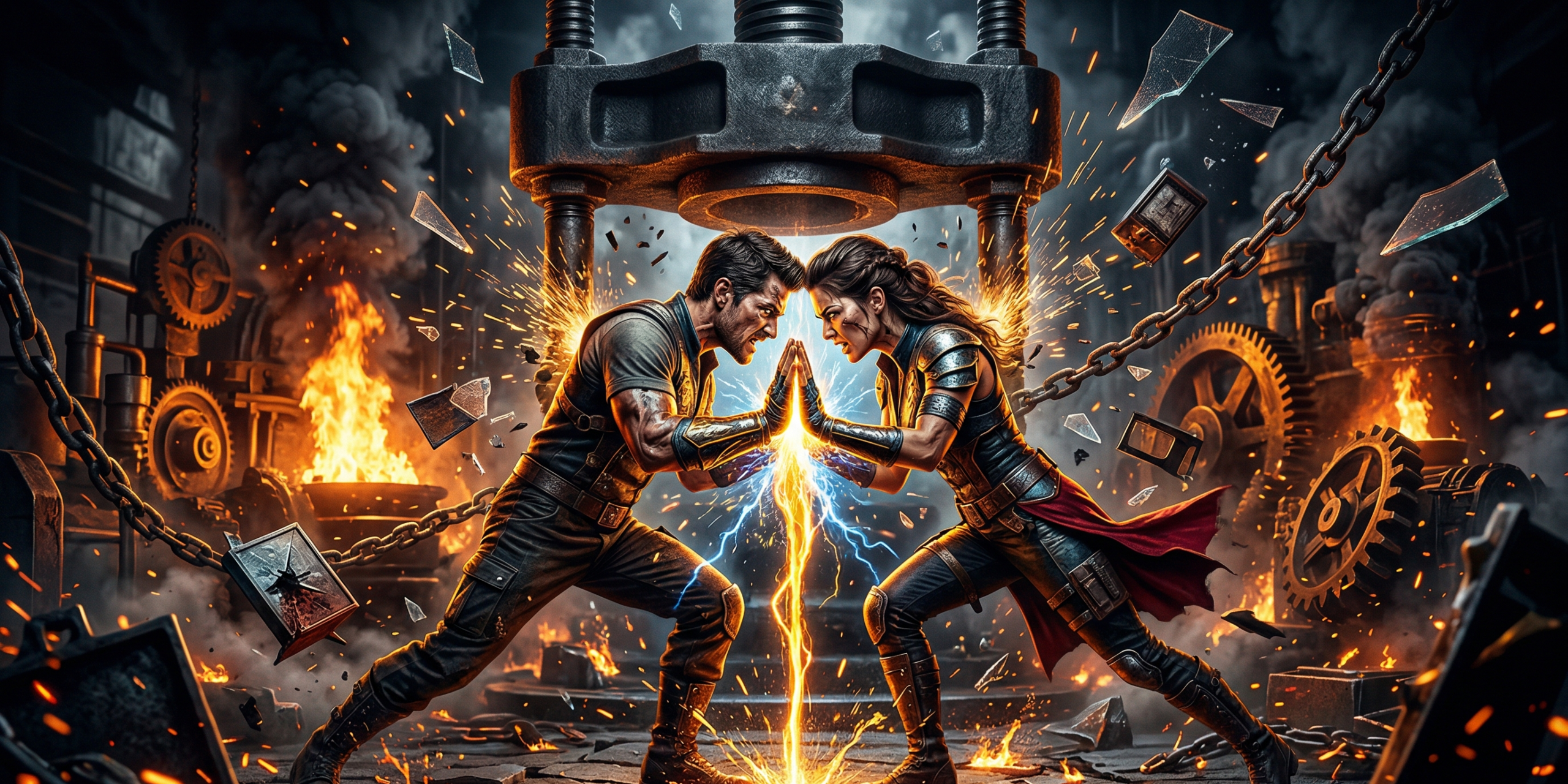
In our modern pursuit of “perfect” lives, we’ve developed a dangerous allergy to conflict. We’ve been told that a healthy relationship—whether professional, romantic, or platonic—should be smooth, harmonious, and essentially “frictionless.” We view an argument or a disagreement as a sign of failure, a crack in the foundation that needs to be patched up as quickly as possible.
But this quest for harmony often creates Relational Fragility. If a bond is only held together by the absence of stress, it is incredibly weak. It’s like a glass sculpture: beautiful to look at, but shattered the moment it’s dropped. In the volatile world of 2026, you don’t need fragile bonds. You need Relational Antifragility.
Coined by Nassim Taleb, “antifragility” describes things that actually gain from disorder, pressure, and stress. An antifragile relationship doesn’t just “survive” a disagreement; it uses the friction to forge a deeper level of trust and understanding that couldn’t have existed otherwise. To build high-impact connections, you must stop avoiding the fire and start using it to temper the steel of your bonds.
The Spectrum of Connection
To understand how to build antifragile bonds, we first have to see where most relationships fall on the spectrum of resilience.
The “Robust” relationship is what most people settle for. They have the “Hard Conversations” (#13), they survive the crisis, and they go back to the status quo. But “status quo” is a declining asset in a fast-moving world. The Antifragile bond is the only one that scales.
The Psychology of Productive Friction
Friction is simply the meeting of two different perspectives, needs, or boundaries. When we avoid friction, we are essentially saying, “I don’t trust the relationship enough to handle the truth.” This leads to Relational Drift, where both parties are operating on assumptions rather than reality.
Antifragility requires Productive Friction. This is conflict that is focused on “The Problem” rather than “The Person.” When you lean into a disagreement with a high-agency partner, you aren’t trying to “win”; you are trying to stress-test your shared reality.
The Structural Test: Think of every disagreement as a structural load test on a bridge. If the bridge creaks, you don’t ignore the sound—you find the weak joint and reinforce it. Every time you navigate a conflict successfully, you “upgrade” the bridge. Eventually, you have a bond that can carry almost any weight.
Strategy 1: The Repair Loop
The most important factor in relational antifragility isn’t the absence of conflict, but the speed and quality of the repair.
Psychological research (notably by the Gottman Institute) suggests that successful relationships have a high “Repair-to-Conflict” ratio. In an antifragile bond, the repair doesn’t just return things to normal; it creates a Post-Traumatic Growth effect.
The Tactic: Practice the “Brutal Autopsy of the Argument.” Once the emotional heat has subsided, sit down and ask:
- “What did we just learn about our communication styles that we didn’t know ten minutes ago?”
- “What ‘Internal Blueprint’ was being triggered for you?”
- “How do we adjust our ‘Operating Manual’ so this specific friction point doesn’t happen again?”
By treating the conflict as Data, you transform a negative emotional event into a structural upgrade.
Strategy 2: Shared Hardship as an Accelerator
There is a reason why soldiers who go through basic training or founders who survive a “near-death” startup experience remain bonded for life. Hardship is a powerful solvent that strips away the “Mask” of social performance.
In 2026, we often try to protect our partners and teams from stress. This is well-intentioned but counter-productive. When you shield a relationship from all hardship, you prevent it from developing the “muscles” it needs to survive.
Relational Antifragility thrives on shared “Calculated Risks.”
- Take on a project that is slightly beyond your collective capacity.
- Have the “Uncomfortable Disclosure” that risks your ego.
- Navigate a difficult external crisis together rather than siloing the stress.
The “We survived that” narrative is the strongest glue in the human experience. It creates a sense of Collective Agency—the belief that together, you can find a way through anything.
Strategy 3: Boundaries as Reinforcement
We often view “Boundaries” as walls that keep people apart. In the antifragility framework, boundaries are actually the “Load-Bearing Walls” that make the structure possible.
A relationship with no boundaries is “Melted.” It’s a mess of codependency and unspoken expectations. Friction often occurs when one person bumps into a boundary they didn’t know existed.
Instead of seeing this as an “affront,” view it as a Mapping Exercise.
When a partner says “No,” or “That doesn’t work for me,” they are giving you the coordinates of their integrity. By respecting and even celebrating those boundaries, you create Psychological Sovereignty within the bond. You are two “Whole” individuals choosing to connect, rather than two “Halves” trying to complete each other. This independence is what makes the connection resilient to external shocks.
The Breaking Point: Friction vs. Destruction
It is vital to distinguish between Antifragile Friction and Destructive Toxicity. * Friction is about growth, alignment, and truth.
- Toxicity is about control, manipulation, and erosion.
Friction is like a gym workout: it causes “micro-tears” in the muscle that heal back stronger. Toxicity is like an injury: it just causes damage. If a relationship is characterized by “Trust Debt” (#14), gaslighting, or a lack of benevolence, friction will not make it stronger. It will simply accelerate the collapse.
Antifragility requires a foundation of Sovereign Trust. You have to believe that the other person is fundamentally “on your team.” Without that belief, every disagreement feels like an attack rather than an audit.
Building the Antifragile Team
In a professional context, you build this by creating a culture of Radical Candor. Most teams are “Nice” but “Fragile.” They avoid telling the truth to avoid hurting feelings, which leads to “Strategic Drift” and eventual failure.
An antifragile team is one where the “Social Friction” is high because the standards are high. People are expected to challenge ideas, point out flaws, and demand excellence. Because they have a deep foundation of mutual respect, this friction doesn’t destroy the team; it makes their output “Unbeatable.” They become a single, high-output organism that thrives on the very challenges that would crush their competitors.
Conclusion: The Beauty of the Scar
In Japanese culture, there is an art form called Kintsugi, where broken pottery is repaired with gold. The idea is that the piece is more beautiful and more valuable because it was broken. The scars are not hidden; they are highlighted as part of the history of the object.
Relational Antifragility is the Kintsugi of human connection. The strongest bonds are the ones that have been broken and repaired, tested and tempered, pushed to the edge and brought back.
Stop being afraid of the “hard part.” Stop avoiding the disagreement. Every piece of friction you encounter is an invitation to build a version of the relationship that is stronger than the one you have today.
Lean into the friction. Forge the bond. Build for the long game.