

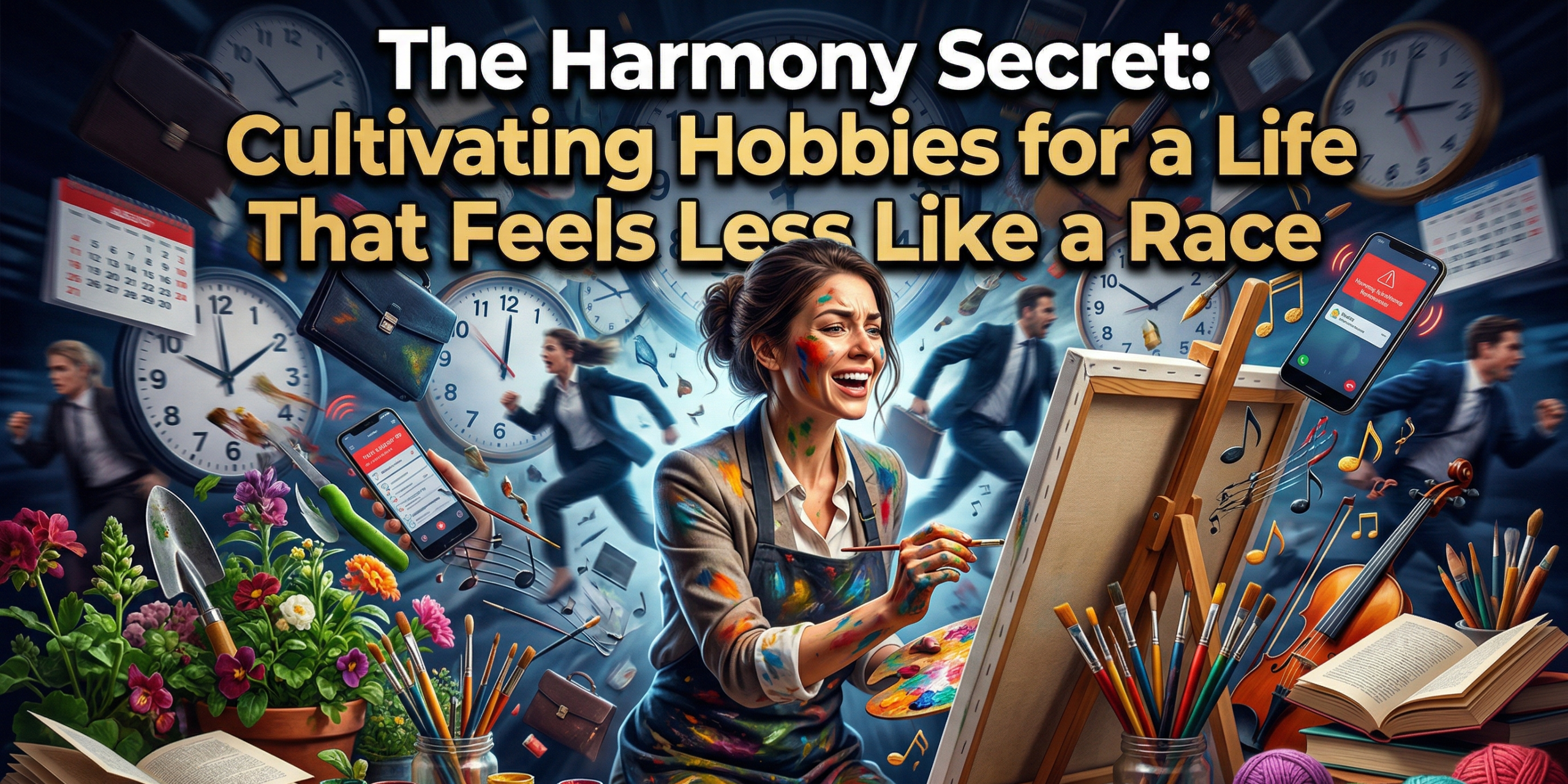
There is a quiet, persistent hum of anxiety that defines the modern experience.
It’s the feeling that you are constantly “behind,” even when you don’t know exactly what you’re racing toward. We live in a culture of “More”—more productivity, more followers, more revenue, more efficiency. We have become so optimized for the “hustle” that we’ve forgotten how to simply exist.
And the most tragic part? We’ve started applying this “Race Mentality” to our leisure.
We don’t just “go for a run”; we track our splits and compare them to strangers on an app. We don’t just “read a book”; we set a Goodreads goal to finish 50 by the end of the year. We don’t just “have a hobby”; we look for ways to turn it into a side-hustle or a “personal brand.”
We have successfully turned our escape hatches into another set of obligations.
If your life feels like a race you can’t win, the answer isn’t to run faster. The answer is to find the Harmony Secret—the art of cultivating a hobby that exists entirely outside the logic of the market.
The Optimization Trap: Why Your Leisure is Exhausting You
We’ve been brainwashed to believe that “unproductive” time is wasted time.
Because of this, we feel a subconscious guilt whenever we aren’t “achieving.” To quiet that guilt, we try to make our hobbies “useful.” We choose hobbies that look good on a resume or feel “high-status.” We seek out skills that we can eventually “monetize.”
But the moment you introduce a metric—a score, a price tag, or a “follower count”—to your hobby, you kill the harmony.
You’ve brought the very “Race” you were trying to escape into the only sanctuary you had left. You’ve replaced Presence with Performance. True harmony happens when you have at least one area of your life where “being bad” at something doesn’t matter. Where the goal isn’t to “win,” but to simply be. ### The Psychology of “Effortless Effort” In Eastern philosophy, there is a concept called Wu Wei—often translated as “effortless action” or “non-doing.” It’s the state of being so aligned with the task at hand that the distinction between the “doer” and the “doing” disappears.
This is the psychological heart of harmony.
When you are in a high-stakes professional environment, every action is calculated. You are thinking two steps ahead. You are managing risks. This creates a high “Cognitive Load” that eventually leads to burnout.
A hobby that triggers Wu Wei provides a cognitive reset. Whether it’s gardening, sketching, or playing a complex piece of music, the activity pulls you into the “Now.” You aren’t “trying” to be happy; you are simply engaged in the process.
The “Harmony Secret” is realizing that the most productive thing you can do for your mental health is to spend time on something that produces absolutely nothing of “market value.”
Why Your Brain Needs a “Zero-Stakes” Zone
Most of our stress comes from the fear of consequences.
In your career, a mistake is a threat. In your social life, a misstep is a judgment. Your nervous system is perpetually on guard, scanning for “errors” that might cost you your status or your security.
A balanced hobby creates a “Zero-Stakes Zone.”
It is the only place in your life where a mistake is a curiosity, not a catastrophe. When you ruin a batch of clay or miss a note, the world doesn’t end. This “Safe Failure” is essential for your brain. It reminds your amygdala—the part of the brain responsible for “fight or flight”—that you are not actually in danger.
By practicing “failure” in a hobby, you are training your nervous system to stay calm under pressure. You are building a “Resilience Buffer” that you carry back into the “Race” of your daily life.
The 3 Pillars of the Balanced Hobbyist
To find true harmony, your creative pursuit needs to be protected from the “Optimization” mindset.
1. The Shield of Non-Competition The moment you start comparing your progress to someone else’s, the harmony dies. Choose a hobby where the only “opponent” is your own curiosity. If you find yourself checking what others are doing in your field, stop. Unfollow the accounts. Delete the tracking apps. Reclaim your right to be “unimpressive.”
2. The Depth of the Process Focus on hobbies that involve “Manual Complexity.” The brain craves the feedback of physical materials—the weight of a tool, the texture of soil, the resistance of a string. Digital hobbies often fail to provide harmony because they feel too much like “Work.” You need to touch the world, not just a screen.
3. The Ritual of “No-Goal” Time Set aside time where the only goal is to “play.” Don’t try to finish a project. Don’t try to learn a specific technique. Just mess around with the tools. This “Goal-less Engagement” is the ultimate antidote to the pressure of the professional world. It allows your subconscious to “untangle” itself without the interference of your ego.
Navigating the “Guilt of the Unproductive”
When you start taking your hobby seriously—not as a “hustle,” but as a sanctuary—you will feel guilty.
You’ll hear a voice in your head telling you that you “should” be doing something useful. You’ll feel like you’re “stealing” time from your family, your career, or your future.
But you have to realize that a person who is “in harmony” is a much better version of themselves for everyone else.
If you are burnt out, reactive, and uninspired, you aren’t “serving” anyone. You are just a hollowed-out version of a human being. By investing in your own joy through a hobby, you are “refilling the tank.” You return to your responsibilities with more patience, more creativity, and a much perspective.
You aren’t “wasting” time; you are buying back your sanity.
The 30-Day Harmony Reset
If your life feels like a race you’re losing, it’s time to change the game.
- Week 1: The Pursuit of “Badness.” Pick one activity you’ve always wanted to try. Spend 20 minutes a day on it with the explicit goal of being terrible. Laugh at your mistakes. Feel the relief of having zero expectations.
- Week 2: The Digital Blackout. When you are engaging in your hobby this week, leave your phone in another room. No photos for social media. No “tracking” of progress. Just you and the material.
- Week 3: The Sensory Deep-Dive. Focus entirely on the physical sensations of your hobby. The smell of the paint, the sound of the tool, the feeling in your muscles. This is “Active Meditation.”
- Week 4: The Integration. Notice how your “Internal Weather” has changed. Are you less snappy at work? Are you sleeping better? You’ll realize that the “unproductive” hobby was the very thing holding your “productive” life together.
The Final Secret
The world will always be a race. There will always be more to do, more to earn, and more to prove.
But you don’t have to live in the race 24 hours a day.
By cultivating a hobby—by protecting a space for play, for failure, and for presence—you are building an internal sanctuary that no market crash or career pivot can touch. You are reminding yourself that you are a human being, not a “human doing.”
The Harmony Secret isn’t about doing less. It’s about being more.
Stop running for a second. Pick up the tools. The race can wait.
The life you’ve been looking for is right here, in the middle of the play.