

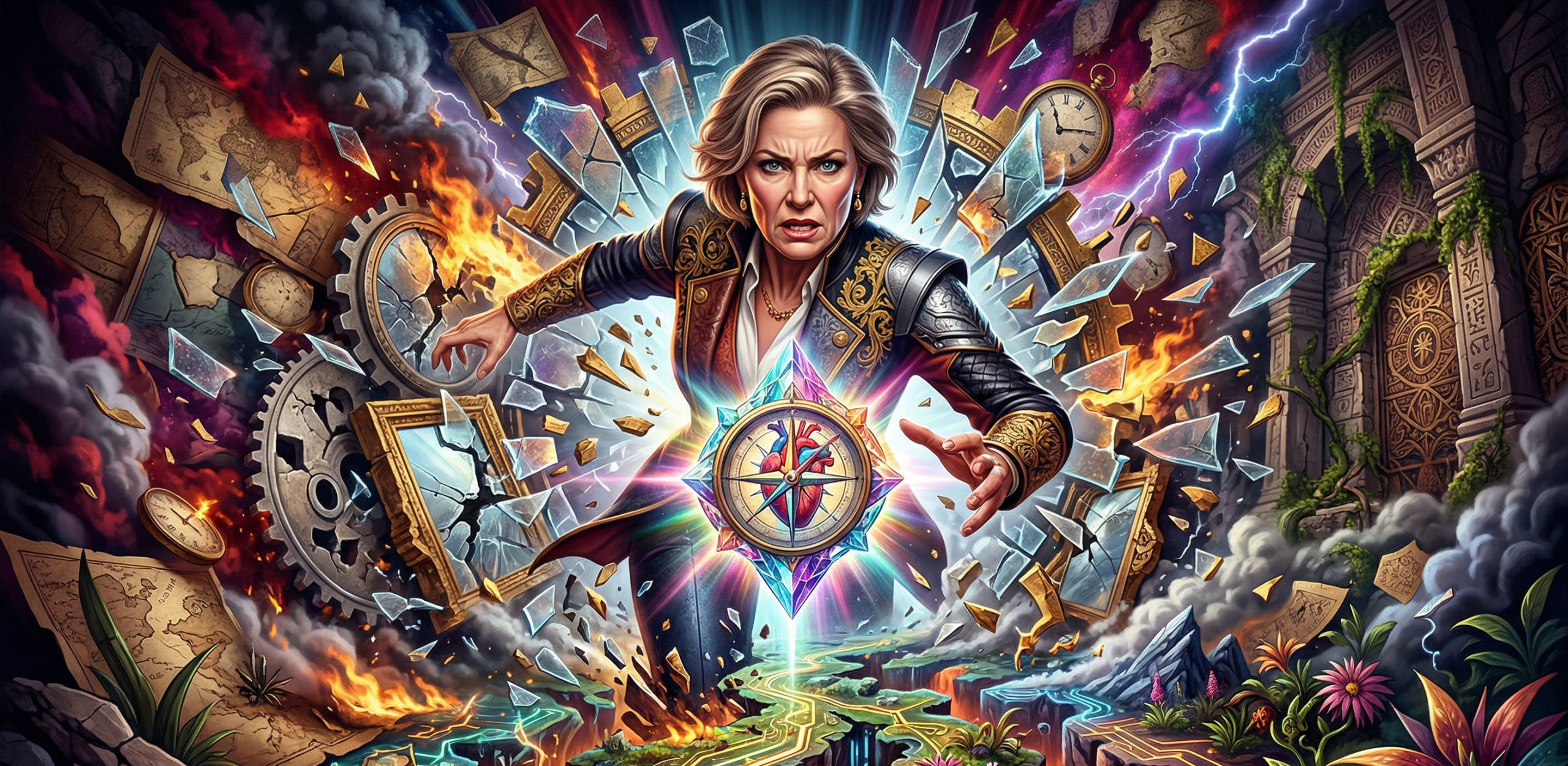
We are often sold a version of personal development that looks like a sleek, upward-trending arrow. We imagine that once we decide to “improve,” we simply gather information, apply it, and watch our lives transform in a linear, predictable fashion.
But anyone who has actually tried to change knows the truth: Growth feels like a fight.
It isn’t a smooth highway; it’s a trek through dense psychological undergrowth. There is a specific kind of friction that occurs when your current reality grinds against your future potential. If you don’t understand the “map” of this friction, you’ll likely mistake the discomfort for a sign that you’re going the wrong way, when in fact, it’s the only proof that you’re moving at all.
The Zones of Transition
Psychology suggests that we don’t just “jump” into growth. We migrate through specific emotional territories. Understanding where you are on this map is the difference between persistent progress and premature quitting.
- The Comfort Zone: This is the land of the “known.” It feels safe, but it is chemically stagnant. There is no challenge here, which means there is no neuroplasticity.
- The Fear Zone: The moment you step out, you hit the wall of anxiety. This is where you find excuses, lack self-confidence, and are most affected by the opinions of others. Most people retreat here, thinking the fear is a “Stop” sign.
- The Learning Zone: If you push through the fear, you begin to acquire new skills and deal with challenges. Your “map” is expanding.
- The Growth Zone: This is where you find purpose, set new goals, and conquer objectives. Your identity has officially shifted.
The Pain of Cognitive Dissonance
One of the hardest parts of navigating personal development is the Identity Friction.
When you start acting like the person you want to be—more disciplined, more assertive, more focused—your brain experiences “Cognitive Dissonance.” This is the psychological discomfort of holding two conflicting beliefs: “I am a person who struggles with [X]” vs. “I am currently doing [X] successfully.”
To resolve this pain, your brain will often try to sabotage your new behavior to bring it back in line with your old self-image. You might feel like an “imposter” or feel a strange urge to “be yourself” (which usually just means “be your old, comfortable self”).
Navigating the map requires you to be okay with being a “hypocrite” for a while. You have to act your way into a new way of being before your brain gives you the emotional “clearance” to feel like it’s real.
The Yerkes-Dodson Law: Finding the “Sweet Spot” of Stress
Growth requires stress, but not all stress is created equal. The Yerkes-Dodson Law dictates that performance increases with physiological or mental arousal, but only up to a point.
If you have too little friction (Comfort Zone), you are bored and stagnant. If you have too much friction, you enter the “Panic Zone,” where your prefrontal cortex shuts down and you can’t learn anything.
The “Growth Map” is about staying in the Zone of Optimal Anxiety. It’s the place where you are slightly overwhelmed but still functional. It’s the feeling of being “at your limit” without crossing over into burnout. If you aren’t feeling a little bit of “healthy stress,” you aren’t on the map; you’re still in the parking lot.
Strategies for the Journey
- Lower the “Activation Energy”: In chemistry, reactions need a spark to start. In psychology, the “start” is the hardest part. If the friction is too high, shrink the task until the resistance disappears.
- Label the Resistance: When you feel the urge to quit, name it. “This is the Fear Zone. This is my amygdala trying to keep me safe.” Labeling moves the process from your emotional brain to your logical brain.
- Audit Your “Safety Nets”: We often stay stuck because we have “Secondary Gains”—benefits we get from staying the same (e.g., people don’t expect much from us, or we don’t have to risk rejection). Identify what you’re gaining by not growing.
The “Insights from Psychology” tell us that the path to a better version of yourself isn’t paved with “good vibes.” It’s paved with the courage to be uncomfortable. The friction isn’t an obstacle to the journey; it is the journey.
When you feel the grind, don’t look for an exit. Look for your compass. You’re exactly where you need to be.
Which of the four zones—Fear, Learning, or Growth—do you feel you’re currently navigating in your most important project?